
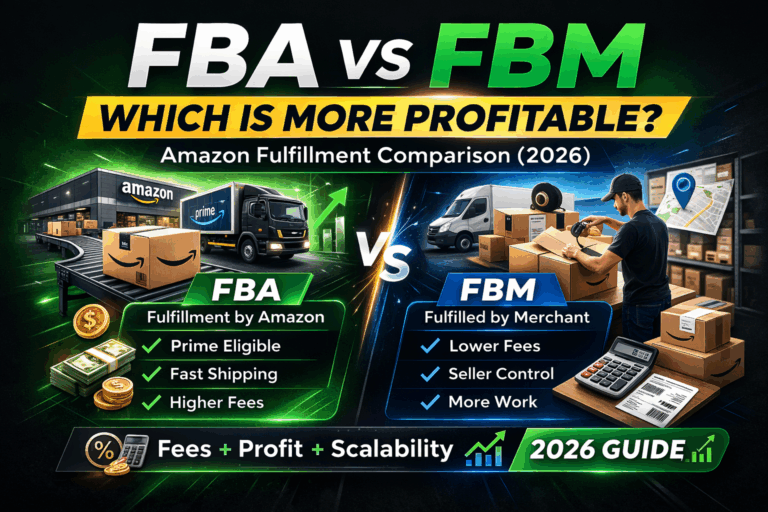
Selling on Amazon means choosing between FBA (Fulfillment by Amazon) and FBM (Fulfilled by Merchant). Both models have different cost structures, operational demands, and profit potential.
In this FBA vs FBM guide, we break down the real profitability differences between FBA and FBM, including fees, shipping costs, advertising impact, and long-term scalability.
Amazon sellers can fulfill orders in two main ways: Fulfillment by Amazon (FBA) and Fulfillment by Merchant (FBM). With FBA, Amazon handles storage, packing, shipping, and customer service. With FBM, the seller is responsible for storing inventory and shipping orders directly to customers.
What Is FBA?
FBA allows sellers to send inventory to Amazon’s warehouses. Amazon handles storage, packing, shipping, customer service, and returns.
FBA products are eligible for Prime, which can significantly increase conversion rates. We break down all referral, fulfillment, and storage costs in our complete guide to Amazon FBA fees.
The most accurate way to determine profitability is to calculate both scenarios using real numbers, including fees, shipping, and product cost.
However, sellers pay:
- Referral fees
- FBA fulfillment fees
- Storage fees
- Long-term storage fees
What Is FBM?
FBM (Fulfilled by Merchant) means the seller stores inventory and ships products directly to customers.
Amazon still charges referral fees, but sellers avoid FBA fulfillment and storage costs.
Instead, sellers must handle:
- Warehousing
- Shipping
- Returns
- Customer service
FBA vs FBM Fee Comparison
Referral Fees
Both FBA and FBM sellers pay Amazon referral fees. These are typically around 15% but vary by category.
Fulfillment Costs
FBA:
Amazon charges picking, packing, and shipping fees based on size and weight.
FBM:
Sellers pay carrier shipping costs directly, which may be higher or lower depending on negotiated rates.
Storage Costs
FBA:
Monthly storage fees + Q4 increases.
FBM:
No Amazon storage fees, but sellers must cover warehouse or home storage costs.
Which Model Has Higher Profit Margins?
Profitability depends on product type.
FBA is often more profitable when:
- Products are small and lightweight
- Prime eligibility boosts conversion
- Sellers want automation and scalability
FBM may be more profitable when:
- Products are large or heavy
- Sellers have low shipping rates
- Inventory turnover is unpredictable
There is no universal winner. The math depends on your numbers.
How to Calculate FBA vs FBM Profit
To compare accurately, you must calculate:
Sale Price
Referral Fee
Fulfillment Cost (FBA fee or Shipping cost)
Storage Cost
Product Cost
Advertising Spend
Net Profit = Sale Price – Total Costs
Instead of estimating, use our:
It allows you to compare FBA and FBM scenarios instantly.
Is FBA More Scalable Than FBM?
FBA is generally easier to scale because Amazon handles logistics.
FBM may offer more control but requires operational capacity.
Scalability often determines long-term profitability more than raw margin.
Final Verdict: FBA vs FBM in 2026
FBA tends to win in conversion rate and automation.
FBM can win on cost control for certain products.
The most profitable model depends entirely on:
- Product size
- Shipping rates
- Storage duration
- Advertising efficiency
The only reliable way to decide is to run the numbers.
Common Mistakes When Choosing Between FBA and FBM
- Not factoring in all FBA fees (storage, long-term storage, returns)
- Underestimating shipping and handling costs for FBM
- Ignoring conversion rate differences between Prime and non-Prime listings
- Choosing fulfillment method based on convenience instead of profit
- Not calculating break-even point before running ads
Avoiding these mistakes can help sellers choose the most profitable fulfillment strategy for their products.
For sellers who want to understand the full breakdown of fees and fulfillment options, it’s worth reviewing Amazon’s official resources directly. You can find detailed information about FBA fees, storage costs, and fulfillment policies inside Amazon Seller Central. This can help you get a more accurate picture of how Amazon calculates costs and how those fees may impact your overall profit depending on the product and fulfillment method you choose.
Frequently Asked Questions
What is cheaper, FBA or FBM?
It depends on product size and shipping cost. Small, lightweight products often benefit from FBA efficiency, while oversized items may be cheaper with FBM.
Do FBA products rank higher?
Prime eligibility and faster shipping can increase conversion rates, which may indirectly improve ranking.
Can you switch between FBA and FBM?
Yes. Many sellers use a hybrid approach, testing both fulfillment methods to maximize profit.