
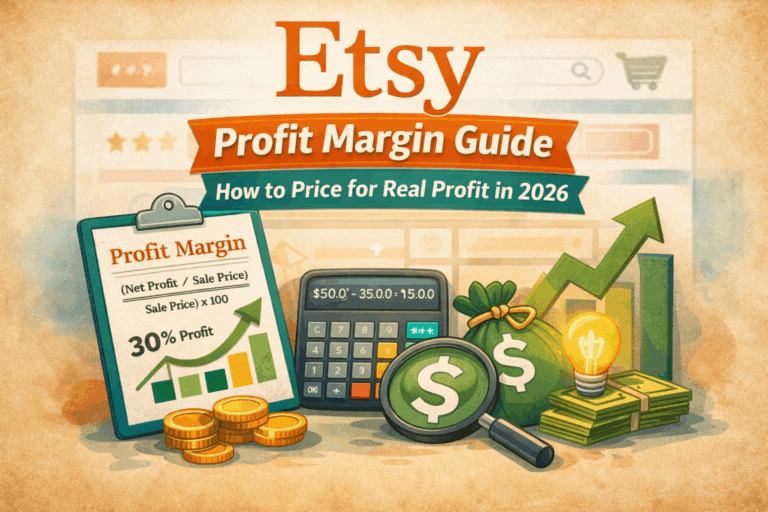
Many Etsy sellers focus on making sales — but not enough focus on profit margin.
If you price your products incorrectly, Etsy fees, payment processing, and shipping costs can quickly eliminate your earnings.
In this guide, we explain how to calculate Etsy profit margin correctly and how to price for sustainable profit in 2026.
What Is Profit Margin on Etsy?
Profit margin is the percentage of revenue you keep after covering all costs.
Formula:
Profit Margin = (Net Profit ÷ Sale Price) × 100
Your goal is not just to sell — it’s to maintain a healthy margin after Etsy fees and expenses.
To fully understand how to price your products and maintain a healthy margin, read our Etsy Profit Margin Guide (How to Price for Real Profit in 2026), where we break down fees, profit calculations, and proven pricing strategies used by successful sellers.
How to Calculate Etsy Profit Margin
To calculate your true profit, you must include every cost involved in the sale — not just materials.
- Product cost (materials + labor)
- Listing fee ($0.20)
- 6.5% transaction fee
- Payment processing fee (3% + $0.25 in US)
- Shipping cost
- Packaging cost
- Advertising cost
If you’re unsure how Etsy’s listing, transaction, and payment processing fees work, review our complete breakdown of Etsy fees before pricing your products or directly on Etsy to understand exactly how each fee impacts your profit margin.
Net Profit = Sale Price – Total Costs
Profit Margin = Net Profit ÷ Sale Price
Example:
Sale price: $50
Total costs: $35
Net profit: $15
Margin = 15 ÷ 50 = 30%
What Is a Good Profit Margin on Etsy?
There is no universal number, but many successful sellers aim for:
30%–50% margin
Lower margins can work for high-volume sellers.
Higher margins are needed for handmade or low-volume products.
If your margin falls below 20%, advertising can quickly make your product unprofitable.
Common Pricing Mistakes Etsy Sellers Make
Ignoring Fees
Many sellers forget to include listing renewals and payment processing fees.
Underpricing to Compete
Competing solely on price often destroys margin and brand positioning.
Not Accounting for Labor
Your time has value. Labor must be included in cost calculations.
How to Price Your Etsy Products for Profit
Instead of guessing, work backward.
Step 1: Decide target margin (ex: 40%)
Step 2: Calculate total product cost
Step 3: Adjust sale price until margin target is met
If you struggle with the math, use our:
It automatically calculates net profit and margin in seconds.
How Advertising Impacts Etsy Profit Margin
If you use Etsy Ads or Offsite Ads:
Your effective margin decreases.
Example:
If you have a 35% margin
And spend 10% on ads
Your real margin drops to 25%
Understanding this prevents scaling unprofitable listings. Before running ads, make sure you understand the true cost. Our How Much Do Etsy Ads Cost? (2026 Full Breakdown for Sellers) guide explains Etsy Ads, Offsite Ads fees, and how they impact your profit margin so you can scale without losing money.
Why Most Etsy Sellers Think They’re Profitable (But Aren’t)
One of the biggest mistakes Etsy sellers make is assuming they’re profitable based on revenue alone.
Just because you’re making sales doesn’t mean you’re making money.
Many sellers only subtract material costs and overlook the full picture — including fees, shipping, and advertising. This creates a false sense of profitability and leads to underpricing.
Here’s a common scenario:
- You sell a product for $40
- Your material cost is $15
- You think you made $25 profit
But after factoring in:
- Etsy fees
- Payment processing
- Shipping
- Packaging
- Ads
👉 Your real profit might only be $8–$12
That’s a huge difference — and it directly impacts your ability to scale.
The Hidden Danger of Low Margins
Low margins don’t just reduce profit — they limit your growth.
If your margins are too tight:
- You can’t afford to run ads
- You can’t offer discounts or promotions
- You have no buffer for returns or damaged items
- Scaling becomes risky instead of sustainable
This is why experienced Etsy sellers focus on profit-first pricing, not just competitive pricing.
Profit vs Revenue Mindset Shift
Successful sellers think differently:
❌ Beginner mindset:
“How can I get more sales?”
✅ Smart seller mindset:
“How can I make each sale more profitable?”
This shift is what separates hobby sellers from scalable businesses.
👉 Key takeaway:
Always calculate your true profit, not just your revenue.
Because at the end of the day, profit — not sales — is what actually pays you.
Before pricing your products, it’s important to understand your total costs — our How Much Does It Cost to Start an Etsy Shop in 2026? guide breaks down everything you need to budget for as a new seller.
Frequently Asked Questions
How much profit should I make per Etsy sale?
It depends on volume, but many sellers aim for at least 30% margin after all fees.
Is 20% profit margin enough on Etsy?
It can work for high-volume sellers, but it leaves little room for advertising or unexpected costs.
How do I increase my Etsy profit margin?
You can increase margin by raising prices, lowering production costs, improving conversion rate, or reducing ad spend.